The Friction of Us
In the City of Jericho, the only thing more dangerous than starving is being seen.
Marrow is an "unclaimed asset," a ghost living in the rusted gears of an abandoned clock tower. He’s spent his life avoiding the Watchmen and the shadow of The Forge—the brutal labor camp where orphans are processed into mindless cogs for the state. He is tired, he is weathered, and he knows that in this world, trust is a luxury he can’t afford.
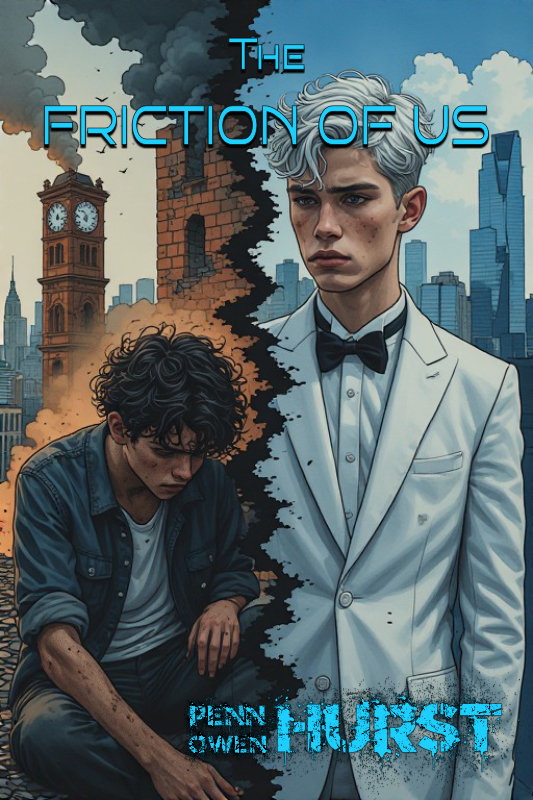
Cas Thorne has everything a "Silver" could want: a name, a future, and a life of sterile perfection in the Halo. But the filtered air feels like a shroud. When he takes a wrong turn into the ruins and finds a boy with a sharpened rebar and eyes like flint, he doesn't see a threat. He sees the only real thing he’s ever touched.
What starts as a series of forbidden visits becomes a desperate act of rebellion. When the state orders the "redevelopment" of the ruins, Cas and Marrow are thrust into the very machine they feared most. Now, they must navigate the psychological rot of The Forge and a world designed to break them.
In a future that demands efficiency over empathy, their greatest weapon isn't a blade or a bomb—it’s the choice to show up for each other when the world tells them they don't exist.
Our story takes place in The City of Jericho, on the shores of Lake Michigan, secretly referred to as “Old Chicago”, to those who were around before the collapse.
It’s 2087 and “Big Brother” (ref: the 1984 novel by George Orwell) has come to fruition. Propaganda is everywhere promoting the regime’s “Efficiency over Empathy” policies.
In 2030 the wealth gap between the rich and poor that been increasing since the late 1900s and has grown so vast that middle class has been completely eradicated. Now, you’re either poor or wealthy, essentially creating a ruling class and a slave class.
When the United States economy—followed by the federal government—collapsed in 2030, voting was abolished and the government was taken over by a, fascist—authoritarian, corporate-owned regime. The country is now ruled by a group of eleven ultra-elite people, one from each of the ten remaining cities, called The Board. The board elects one of their friends to be “President of The Board”. The duration of the president’s term is only defined by satisfaction of The Board.
The people who fall between the cracks are known commonly known as “orphans”, to the state, they are unclaimed assets. The orphan population was created primarily due to their parents being arrested for “capital crimes” and disappeared into The Forge system, is a program promoted by the regime as a humanitarian effort to help the orphans and other unclaimed assets to “gain citizenship” by reintegrating them into society. When in reality, it’s a brutal labor camp where people are processed into mindless cogs for the state; their minds are wiped, stripping them from any personal identity, turning them into the “Dulls”, who are happy to do anything the regime asks of them.
It is unlawful for the classes to interact with each other. Every community, in every city, is heavily patrolled by The Watchers—the regime’s paramilitary police force—and an army of drones to insure the separation between the classes is maintained. “Sweeps” are conducted on a regular basis. Any persons found fraternizing with someone from the opposite class is shot on the spot.
Every small community across the country was deemed not profitable, and inefficient, by the regime so all “citizens” and non-citizens alike were required to abandon their homes and move into the cities.
This created The Dead Zone.
All farming and manufacturing is owned and controlled by the government in “Production Districts” outside the city walls, creating a food shortage for the poor, not the rich.
The Production Districts are where the poor work. Conveniently separated from the wealthy class. The Dead Zones are full of ghost towns and open land known to the resistance as the “Free Lands.